Introduction
Extreme heat is an especially insidious health threat to those living and working within carceral facilities (Brunn et al., 2025). Upgrading environmental control systems in California’s state prisons is imperative to reduce the cruel and unusual suffering of incarcerated populations caused by extreme heat, and the urgency is heightened by the increasingly frequent and hotter heatwaves projected to occur by mid-century (2040–2070).
Legislative efforts to address extreme heat exposure in 2025 were halted, in part due to an initial $10–20 billion cost estimate provided by the California Department of Corrections and Rehabilitation (CDCR) to implement climate control in all facilities (Office of Administrative Law, 2024). AB-2499 (Gipson 2026) has been introduced and requires CDCR to revise emergency plans and implement interior temperature monitoring, anticipated to require a much lower upfront cost since it excludes implementing cooling systems. Current policy research lacks an analysis of the medium- and long-term costs of inaction, particularly regarding how extreme heat alters behavioral outcomes and sentence lengths. Failing to account for these variables risks stalling critical adaptation policies based on incomplete financial data.
This intersect addresses that gap by modeling how unmitigated extreme heat increases illness and death, violence, infractions, credit forfeitures, and recidivism in California’s state prisons, and finds that heat-related increases to time served are projected to add $19–27 million in annual marginal costs to CDCR by mid-century. This intersect then recommends the strategies most aligned with abolition goals to reduce person-years of incarceration: infraction protocol reform for climate emergencies, climate data in parole and credit reviews including retroactive credit restoration, publicly-accessible interior temperature monitoring, and phased facility closure that redirects savings to community-based alternatives.
Methodology
This intersect establishes the extreme heat risk profile for incarcerated populations by applying the shared environmental risk framework to peer-reviewed literature on heat exposure, health vulnerabilities, and behavioral outcomes in carceral facilities.
A Prison Heat Risk Index is then calculated across 31 CDCR state prisons using facility-level hazard, exposure, and vulnerability data. Hazard indicators are derived from Cal-Adapt downscaled climate projections for the mid-century period (2041–2070) relative to a 1991–2020 historic baseline (Cal-Adapt, 2025) and CalEnviroScreen 5.0 air quality percentiles (OEHHA, 2024). Exposure indicators are derived from CDCR cooling infrastructure and indoor heat exposure reports (CDCR, 2026; Raychaudhuri et al., 2025) and urban heat island measurements (Benz & Burney, 2021). Vulnerability indicators are derived from CCHCS health risk classification data (CCHCS, 2025) and CDCR population reports (CDCR, 2025). Facility locations and capacity are from FEMA’s Prison Boundaries dataset (FEMA, 2025). See Appendix D for index methodology and weighting.
To estimate the mid-century marginal increase in incarcerated person-years from extreme heat, projected heat days from the risk index are combined with peer-reviewed effect sizes for heat-related mortality and violence and historic CDCR baseline rates (Table 1). The mortality estimate applies a 5.2% all-cause mortality increase per threshold exceedance day (Skarha, 2023); the violence estimate applies a 20% increase in daily violent interactions on heat days (Mukherjee, 2021). Downstream effects on credit forfeiture, recidivism, and additional sentence length are then modeled from violence increases. The total heat-related marginal cost is calculated by multiplying the projected increase in incarcerated person-years by the current marginal annual cost of $21,534 per incarcerated person (LAO, 2025b). See Appendix E for equations and detailed findings.
Table 1. Heat-related Incarceration Person-years Model Baseline Inputs
| Baseline | Period | Value | Source |
|---|---|---|---|
| Mortality rate | 2016–2019 (pre-COVID) | 3.07 per 1,000 per year | CCHCS Health Care Services Dashboard |
| Violent incidents | 2021–2024 | 9,944 per year | CDCR Performance Measures Incidents Reports |
| Three-year return-to-prison rate | 2013–2018 | 23.7% | CDCR Recidivism Reports |
| Recidivism sentence length (parole violators with new term) | 2023–2026 | 4.4 years | CDCR Population Data Points |
| Credit forfeiture, violent violations | Midpoint 210 days (range: 60–360) | Bird (2022); California Code of Regulations (2024) | |
| Credit forfeiture, non-violent violations | Midpoint 15 days (range: 0–30) | Bird (2022); California Code of Regulations (2024) |
Facility-level hazard, exposure, and vulnerability data compiled for this analysis has been published as an open dataset (Becica, 2026b). This dataset is intended as a resource for researchers, advocates, and policymakers working on carceral facility conditions and climate change.
If a total cost of non-intervention is to be calculated, the marginal increase of incarcerated person-years should be added to the increased annual healthcare costs of exacerbated heat-related illnesses and the cost of lives and healthcare burden of those affected after re-entry, the costs of ongoing litigation, and the cost of lives lost from heat-related death. This total cost is out of the scope of this capstone.
Extreme Heat Risk in State Prisons
Heat Hazard
In 2025, approximately 90,500 people were incarcerated in California state prison facilities (CDCR Population Reports). Currently, 49% of the incarcerated population experience three or more months of days ≥90°F annually; by mid-century, this is projected to rise above 75% (Map 2, Cal-Adapt, 2024). By end-century (2071–2100), 69% of the population will face four or more months of 90°F annually, compared to just 9% today.
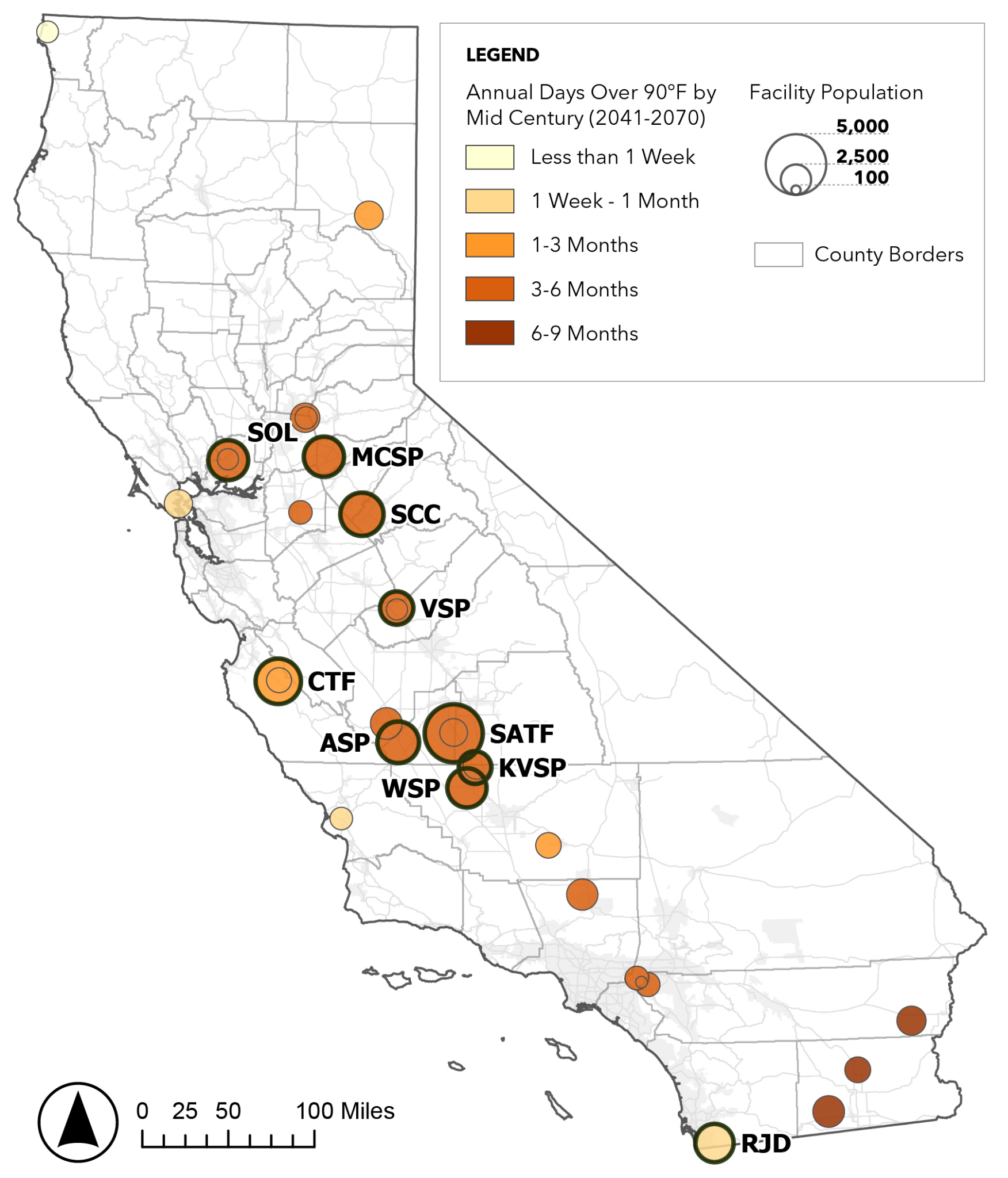
Map 2. Projected heat days over 90°F by the mid-century (2041–2070), with the 10 most populous CDCR facilities highlighted. By mid-century, 75% of incarcerated people are projected to experience 3+ months of 90°F+ days, with a distinct pattern in the Central Valley and inland deserts. The ten highlighted facilities each house at least 3,000 people and together represent 43.1% of CDCR’s 2025 population. Sources: Cal-Adapt 2025, FEMA’s Prison Boundaries 2025.
While facilities in the Central Valley and inland deserts face the highest absolute heat days, coastal facilities face the greatest percentage change in buildings not designed for heat. San Quentin currently averages approximately 7–8 days over 90°F per year; that doubles to 15 days by mid-century (Cal-Adapt, 2025; CDCR, 2023a).
Exposure
California’s prisons were historically sited and designed to utilize geographic isolation and extreme weather exposure as integral parts of their models of punishment (Mendoza, 2019). During the prison-building era of 1984–2000, 23 facilities were sited on idle rural land in communities with surplus labor (Gilmore, 2007); as a result, state prisons are concentrated in rural Central Valley and inland desert locations with greater heat hazard exposure (Ovienmhada, 2024; Abdala et al., 2023). CDCR has acknowledged that during this era of expansion, “the comfort level of the incarcerated population and staff was not a consideration or priority” (CDCR, 2025).
Today, incarcerated individuals are confined in aging buildings (average age of 51 years) constructed with heat-conducting materials and lacking effective cooling (Brunn et al., 2025; CDCR, 2025; OIG, 2025). Asphalt yards, poor ventilation, aging roofs, and lack of vegetation magnify temperatures through urban heat island effects, negating the limited effectiveness of evaporative or mechanical coolers (Ovienmhada, 2024; CDCR, 2023a & 2025; Akbari, 2016) (see Appendix F for engineering interventions to address urban heat island effects).
Vulnerability
The impact of heat exposure is compounded by the demographic composition of the incarcerated population. Heat vulnerability factors including older age, chronic illness, and psychotropic medication use are prevalent in prisons in the United States and California; each of these factors impairs the body’s thermoregulatory capacity and increases cardiovascular strain during heat exposure (Singh et al., 2024). Nationally, 36% are taking medications that increase heat risk (Brunn et al., 2025). As of 2025, 29.6% of California’s incarcerated population is over 50, 15.8% are in the disability placement program, and 59.2% have medium-to-high medical acuity with at least one chronic disease (CCHCS, 2025). People of color, who face higher thermal inequity in their communities and are more likely to enter the carceral system with existing heat-vulnerable illnesses, are disproportionately represented in the California prison population; in 2025, 81.1% of incarcerated were people of color (Hamstead, 2023; PPIC, 2024; CDCR population reports). Combined, these factors produce a population with concentrated biological vulnerability to heat, confined in buildings designed without regard to thermal safety and without individual capacity to reduce their own exposure.
Impacts
The interaction between extreme heat hazard and population vulnerability drives three categories of negative outcomes: illness & death, violence & behavioral infractions, and increased time served.
Injury, Illness & Death
Heat exposure in carceral settings has measurable impacts to injury, illness and mortality. Approximately 40% of incarcerated individuals in California are also assigned to work positions; days above 80°F increase the risk of workplace injuries by 3%, and days above 90°F increase the risk 10% (LAO, 2024; Alahmad, 2025). Extreme heat days are attributable to a 29% increase in suicide watch incidents among men and a 32% cumulative increase in suicide 3 days after a heatwave (Cloud, 2023; Skarha, 2023). In total, every 10°F over the average summer temperatures in carceral facilities is attributable to a 5.2% increase in total mortality (Skarha, 2023). In response to a survey on climate hazards in California prisons in 2023, 44% of respondents who had experienced an extreme heat event reported fearing for their lives during the event, and 40% reported experiencing heat cramps, 61% reported heat exhaustion, and 26% reported heat stroke (Abdala et al., 2023).
Violence & Behavior
Research has also established a causal link between heat and violence in carceral facilities. Heat days are attributable to a 20% increase in daily violent interactions (Mukherjee, 2021). That violence leads to correctional officers issuing violence infraction reports; unfortunately, research does not yet quantify the direct connection between extreme heat and violence infraction rates. However, it is established that personally harmful or unpredictable environments within carceral facilities increase rates of recommitment after release by 20%, and incarcerated victimization has been shown to significantly increase the likelihood of recidivism by up to 32% within 15 months of release (Taylor, 2015; Listwan, 2013). This suggests a direct connection can be made between extreme heat exposure and incarceration rate increases by way of recidivism.
Even less is known quantitatively about the influence of heat on the issuance of rule violation reports (RVRs). Interviews reveal that these violations regularly occur during heatwaves as incarcerated people break rules in their attempts to mitigate the effects of high temperatures, such as showering at unauthorized times, covering windows for shade, modifying clothing, refusing to work in locations such as hot kitchens, constructing their own evaporative “swamp coolers,” or refusing to take mandatory medications that may increase heat risk (Abdala et al., 2023; Trumbo et al., 2024; Brooks, 2025). These coping mitigations lead to a range of disciplinary actions recorded on an individual’s permanent record via issuance of an RVR or Serious RVR (OIG, 2025; Brooks, 2025; Law, 2017; ACLU, 2022). Violation report rates in CDCR facilities have been shown to be better explained by officer discretion than by measurable facility indicators such as security level, suggesting that individual officers are likely a driver of infraction rates during heatwaves (Tahamont, 2019).
Time Served
These violence and behavioral changes directly extend incarceration. For the 62% of the population under determinate sentencing, violence violations could lead to between 60–360 days of good time credit forfeiture, and rule violations 0–30 days of good credit forfeiture (Bird, 2022; California Code Regulations, 2024; Reitz, 2021). When deciding how many good time credits to remove, research has shown that officials are more likely to “consider characteristics of the rule violation rather than inmate characteristics” (Steiner, 2017).
For those under indeterminate sentences, good credits impact Minimum Eligible Parole Date (MEPD) suitability, and in California it was found that an addition of 10 violations reduced the odds of parole grants in half (Bird, 2022; California Code Regulations, 2024; Young, 2016). Consequently, extreme heat creates a cycle of violence and infractions that extends sentences and expands the prison population; unfortunately, research is missing on quantifying the magnitude of the connection between heat days, violations, and credit or MEPD decisions.
Impact and Cost Findings
Overall Heat Risk Index
Outdoor temperature alone does not capture the relative heat risk of people within state prisons. The Prison Heat Risk Index combines hazard, exposure, and vulnerability metrics to calculate a normalized risk score across the 31 CDCR prison facilities and groups them from low to critical (see Map 3, and Appendix D for methods and a detail table).
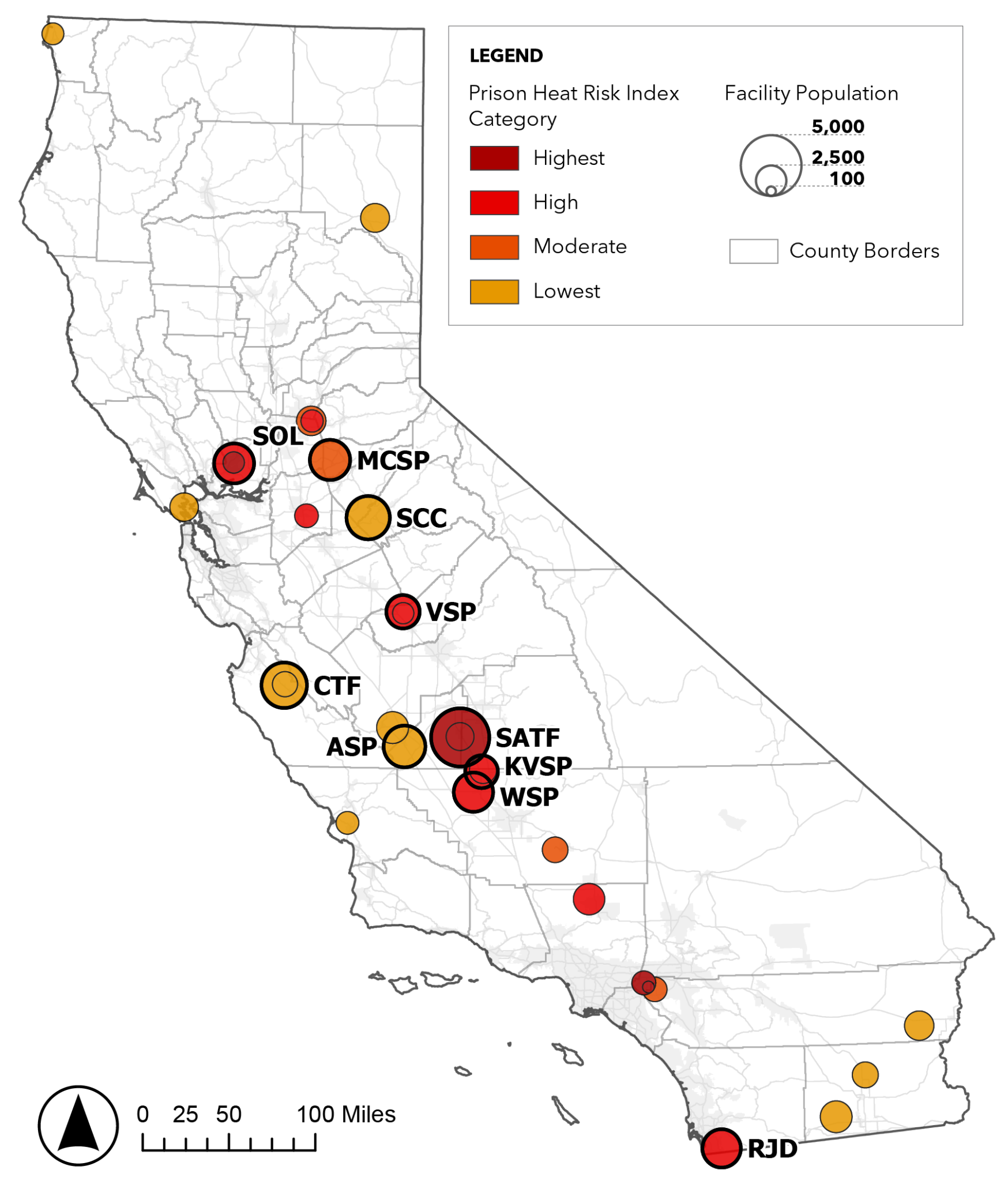
Map 3. Projected relative heat risk of CDCR prisons by mid-century (2041–2070), with the top 10 populous facilities highlighted. The fifteen facilities in the Highest and High risk tiers house 47.7% of the incarcerated population, and 19.6% of their housing units have mechanical AC. Sources: Author’s composite index. See Appendix D for methods and a table view of the data.
There are six prisons in the highest risk category; they house 17.5% of the state’s incarcerated population, average 77% medium-to-high medical acuity per facility, and 18.8% of the housing units in the six facilities have mechanical air conditioning. Three of the six highest risk facilities were chosen for The California Model rollout (CDCR, 2024b: California State Prison Corcoran (COR), CA Substance Abuse Treatment Facility (SATF), and California State Prison Sacramento (SAC)); COR has 0% mechanical AC in their housing units, SATF has 5%, and SAC has 22%.
Cost Projections
Applying the projected hazard, exposure, vulnerability and impact findings to the cost model reveals the marginal cost increases from extreme heat. By mid-century (2040–2070), unmitigated heat exposure is projected to result in one heat-attributable death every 1.4 years, up ~50% from the current estimated heat-related mortality rate, and 873–1,255 minimum marginal increase to incarcerated person-years (Figure 3, see Appendix E for detailed calculations).
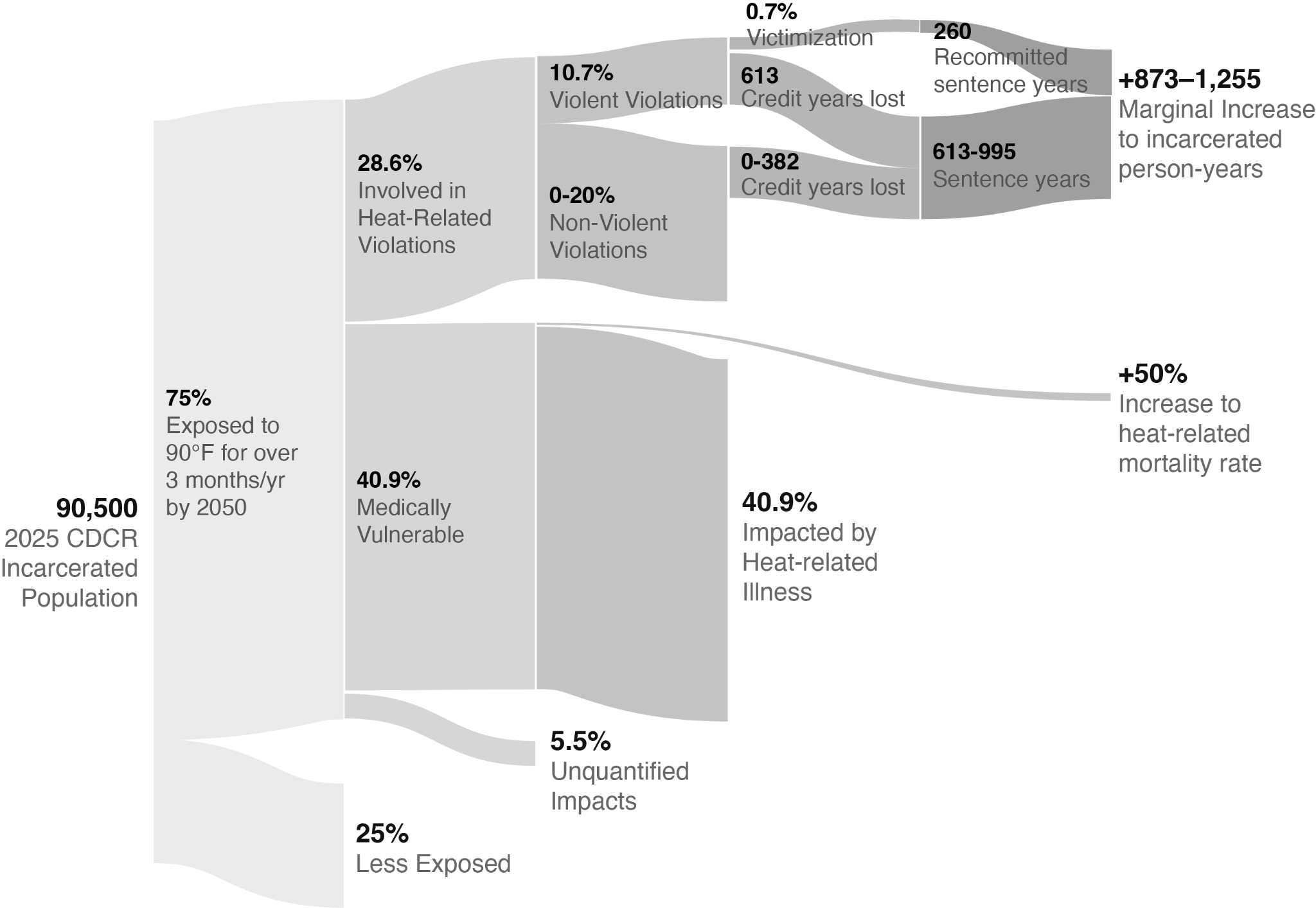
Figure 3. Unaddressed extreme heat is modeled to result in a $19–27 million marginal annual cost from increases to incarcerated person-years by mid-century (2040–2070). Note: this diagrams the percentile of violations, medical vulnerability, and mortality as separate flows; in reality these impacts likely overlap, but that overlap is not quantifiable and does not impact the cost calculation in this report. Sources: Author’s cost model. See Appendix E for methodology and calculations.
This increase in person-years stems from a 10.7% increase in violent violations (resulting in credit loss and recidivism) and a range of non-violent infractions. Applying the Legislative Analyst’s Office marginal cost of $21,534 per incarcerated individual (LAO, 2025b), extreme heat is estimated to add a minimum of $19–27 million in annual marginal costs by the mid-century.
Policy & Legal Context
2026 is a critical year for determining the direction of carceral heat interventions in California; the state currently faces mounting legal and regulatory pressure to address facility conditions. Following findings of Eighth Amendment violations in Coleman v. Wilson (1995), CDCR implemented a heat pathology plan for the highest risk incarcerated people, but recent audits reveal large gaps (OIG, 2025). In 2024, Cal/OSHA implemented indoor workplace heat standards that exempted correctional facilities; in March 2026 the agency released draft language to specifically regulate correctional facilities. Simultaneously, courts are signaling a shift; a 2025 Texas ruling by a federal judge deemed uncooled prisons unconstitutional (Tiede v. TDCJ). Between 2022 and 2026, California spent ~$181.2 million in lawsuits related to unconstitutional conditions of confinement in state prisons, with $56.9 million already expected in FY 2026-27 (see Appendix G).
Since 2020, CDCR has revised its facility closure criteria to weigh building conditions and upgrade costs, resulting in the closure of several poorly maintained, heat-exposed facilities. In 2023, Governor Newsom unveiled “The California Model” to transform the prison system from punishment to rehabilitation; San Quentin was the first facility to undergo conversion, with five others identified for future phases (CDCR, 2024b).
In response to heat exposure specifically, CDCR has responded with a mix of construction and pilot programs. In 2023, $246M was dedicated to cooling projects in five facilities, one of which was completed in 2024 at Ironwood State Prison for $192 million. In January 2025, CDCR launched a $69 million “cooling pilot program” at four facilities with the goal of testing the effectiveness of various cooling technologies; in June 2025 CDCR released a status report on the pilot and revised its statewide cooling estimate to $6 billion. Soon after, the Office of the Inspector General confirmed the poor condition of current cooling systems and found that CDCR failed to adequately monitor facility temperatures (OIG, 2025).
In summary, CDCR has several fragmented facilities planning projects underway and mounting legislative, regulatory and legal pressure in 2026 to respond quickly and effectively.
Recommendations
Central to intervening in prison facilities is the tension between investing in the state carceral system and long term strategies toward decarceration. To mitigate both the human and fiscal costs of extreme heat, the state must move beyond reactive measures toward comprehensive planning.
Integrate Climate Mitigation into Long-Term Rehabilitation Planning
This intersect finds that uncooled facilities will directly increase person-years of incarceration, adding up to $27 million in annual marginal costs by mid-century. Implementing large-scale cooling in existing punishment-model facilities would address the immediate hazard, but meets the definition of carceral humanism: improving conditions within punishment infrastructure in ways that expand correctional budgets and extend the political life of facilities, without reducing the number of people incarcerated or shifting resources toward the communities where disinvestment concentrated both heat and incarceration (Sanders, 2026; Critical Resistance, 2022).
Rather than retrofitting obsolete buildings, CDCR should develop a long-term plan that integrates heat intervention with the facilities supporting the California Model of rehabilitation, identifying which facilities are viable for long-term programming and prioritizing those for climate upgrades. The Prison Heat Risk Index provides a starting point: the six highest-risk facilities that house 17.5% of the population should be assessed against their rehabilitation alignment before large capital investments are committed.
The full costs of cooling and emergency upgrades should be incorporated into CDCR’s existing facility closure criteria, aligning infrastructure planning with climatological timelines. Closing the most heat-vulnerable and highest-cost facilities would then produce a triple savings: eliminating current operational costs of the prison and the capital expenditure of retrofitting infrastructure that is misaligned with rehabilitation goals, and avoiding the projected $19–27 million in annual marginal incarceration costs due to heat. These savings should be redirected toward community-based alternatives that reduce incarceration and support re-entry.
Mandate Publicly-Accessible Interior Temperature Monitoring
Even when cooling infrastructure exists, institutional negligence can render it ineffective; in Texas, litigation in Tiede v. Collier (2024) exposed years of dangerous heat exposure despite air conditioning (Brunn et al., 2025). Publicly-accessible, real-time interior temperature data is a prerequisite for every other heat intervention in carceral facilities — it is the mechanism by which cooling mandates become enforceable and conditions become visible to the public, legislators, and courts. AB-2499 (Gipson 2026) is currently advancing this strategy.
From an abolitionist perspective, transparency is an accountability tool: it makes the conditions of incarceration harder to conceal and strengthens the evidentiary basis for litigation, legislative action, and facility closure decisions.
Reform Infraction Protocols for Climate Emergencies
Given the findings that infractions are issued based on officer discretion, upcoming emergency response plans must also include strategies for reducing officer discretion in issuing non-violent infractions during climate emergencies. At a minimum, infractions issued during climate emergencies should be recorded as such within the RVR.
From an abolitionist lens, this reform directly reduces person-years of incarceration by preventing heat-driven infractions from extending sentences, shrinking the system’s hold on individuals without requiring new infrastructure or investment.
Incorporate Climate Data into Parole and Credit Reviews
Given the finding that officials consider the facts and context of a rule violation over other factors in decision-making, climate emergency data in the RVR must inform good time credit and parole suitability reviews.
A retroactive assessment of credit removals during past heat events should be conducted to quantify historic impacts on time served, inform potential operational changes, and retroactively revise any time served impacts that are unwarranted. Retroactive credit restoration for heat-affected individuals is one of the most direct decarceration mechanisms available within the existing system; it reduces time served and returns people to their communities sooner.
Fund Critical Research Gaps and Provide More Structured Data
To refine cost modeling, the state should support research into the causal relationships between heat days and infraction rates, credit forfeiture, parole decisions, and post-release recidivism.