Introduction
On June 20, 2024, California’s Occupational Safety and Health Standards Board voted unanimously to adopt the state’s first indoor heat standards for workplaces: employers must cool indoor spaces below 87°F when workers are present. The board made one exception. Prisons and jails were excluded after the Department of Finance withdrew its support, citing a cost estimate of $10–20 billion to bring correctional facilities into compliance (Shapiro & Venkat, 2024).
Two weeks later, California entered its hottest month on record. In Sacramento, the county ended water deliveries to homeless encampments on July 1; two unhoused residents died in the first week of the heatwave (Hansen, 2024). On Skid Row in Los Angeles temporary cooling centers opened a month late, and Oakland’s Town Nights community violence prevention events lost city funding; these were places where vulnerable residents might otherwise find water, shade, and safety during heatwaves (Botel, 2024; Ravani, 2025; Urban Institute, 2025). People experiencing homelessness face substantially higher mortality risk during extreme heat (Lin et al., 2024), and police routinely clear encampments during heatwaves, forcing residents to move belongings in triple-digit temperatures or face citations and arrest, disproportionately for minor offenses that feed California’s incarceration pipeline (Hing, 2023; Camnitzer, 2025).
On July 4th at the Central California Women’s Facility in Chowchilla, one of the facilities the new heat standards did not cover, outside temperatures reached 109°F. Inside, a swamp cooler blew warm air into the cells, with no chance to overcome the heat retention effects of the thick uninsulated concrete walls. Adrienne Boulware was prescribed lithium, a psychiatric medication that impairs the body’s ability to regulate heat. Staff were required to monitor incarcerated people on heat-sensitive medications every few hours; a court monitor later found compliance across the state’s prisons was “elusive” (Kuang, 2025). Boulware collapsed the next day and arrived at a hospital with a body temperature of 106.7°F. She died hours later. In a 2023 survey of incarcerated people who had experienced an extreme heat event in a California prison, 44% reported fearing for their lives, and heat days in carceral facilities are attributable to a 5.2% increase in mortality (Abdala et al., 2023; Skarha, 2023).
The lack of cool safe places in urban centers during heatwaves, the exclusion of those within carceral facilities from heat protections, and the encampment sweeps that criminalize survival in the heat are not separate failures. Extreme heat and mass incarceration are connected crises in California, rooted in the same geographies of disinvestment and compounding each other at every stage of criminal justice contact. Policy and funding have historically treated them as separate administrative domains. This capstone investigates the opportunities in addressing both.
The fiscal, moral, and public safety cases for decarceration are well established (Aviram, 2015; Percival, 2015; Gottschalk, 2015). The carceral system is woven into the same governance and investment structures that shaped California’s urban geographies; accelerating heat exposure from climate change strengthens each argument for decarceration and creates new urgency for reinvestment in community-based alternatives.
Research question: How does extreme heat compound each stage of criminal justice contact, from community through incarceration through reentry, and do current policy and investment responses address both crises or leave the systems that produced them intact?
To identify where intervention is most actionable within existing policy and funding frameworks, this capstone is organized into three chapters. Each chapter examines an intersect of a person’s experience with extreme heat along the criminal justice continuum, the phases through which a person moves from community through incarceration through reentry (Wood, 2019). Each addresses a different population, geography, and research question:
Residents of urban neighborhoods where incarceration rates and heat islands converge.
What characterizes community-led resilience projects that address both climate adaptation and criminal justice diversion in urban neighborhoods?
People incarcerated in California’s 31 state prisons.
What are the human and fiscal costs of unmitigated extreme heat in prisons, and can articulating those costs accelerate decarceration?
People living in community under the supervision constraints of state parole and county probation.
What policy gaps expose people on state parole and county probation to extreme heat and further reincarceration risk?
Considering the system as a whole, from community through facility through re-entry, reveals opportunities that siloed approaches miss, and centers community wellbeing as the primary outcome of investment. Because the same processes of disinvestment and segregation that produced mass incarceration also concentrated extreme heat vulnerability, decarceration and reinvestment in communities is the most direct strategy for reducing both.
Community-based diversion refers to the full spectrum of programs, services, and infrastructure investments that reduce contact with the criminal justice system, from upstream prevention and resilience programming to alternatives to arrest, sentencing, and incarceration. In the criminal justice field, this is frequently called the “front” of the criminal justice system.
Resilience hub describes a community-serving facility that combines social services, emergency preparedness, and climate adaptation functions; the characteristics that distinguish resilience hubs from other community centers are detailed in Intersect 1.
Community corrections refers to the systems of state parole and county probation through which individuals serve portions of their sentences or post-release supervision in the community rather than in a facility; the regulatory context is detailed in Intersect 3.
Each intersect chapter uses an environmental risk framework to map heat hazard impacts on geographies and populations, and proposed interventions are assessed with an abolitionist framework to evaluate whether they reduce the reach of the carceral system or reinforce it. Interviews with current activists and scholars, whose work centers and empowers incarcerated or formerly incarcerated individuals, guide case study selection. This capstone limits specific recommendations to topics that already have research and advocacy led by incarcerated or formerly incarcerated individuals; for all other topics, this capstone frames the questions where more extensive community-led research or advocacy could be furthered.
Background
Mass incarceration and extreme urban heat are co-occurring conditions in California urban geographies. The neighborhoods with the highest heat exposure were shaped by redlining and sustained disinvestment; they are also the neighborhoods with the highest incarceration rates. Tracing the structural roots of both conditions through three periods of settler-colonial land dispossession, postwar welfare state establishment, and the neoliberal era of carceral expansion and urban disinvestment reveals the political, economic, and racial processes that produced both outcomes.
Settler-Colonial Foundations
The carceral infrastructure of California did not originate as a crime prevention effort but as a clearing out of those who did not conform to the settler order. In the mid-nineteenth century, as the United States seized California from Mexico and Anglo settlers arrived during the Gold Rush, militias were used to clear Indigenous people from city sites and force them into farmwork and construction labor; Indigenous people who resisted were jailed (Wolfe, 2006; Bautista Duran, 2024; Madley, 2016). In Los Angeles, the first act of governance during the transition from Mexican to U.S. rule in the late 1840s was the hiring of a jailor (Hernández, 2017). Frontier warfare personnel and tactics provided the manpower and methods for the first police forces that shaped the professionalized departments that followed; an expression of settler colonialism’s logic of elimination, which operates not as a one-time event but as a structure that persists as long as settlers remain on Indigenous land (Bautista Duran, 2024; Go, 2020; Wolfe, 2006). The racial formation of property was forged in this period: whiteness functioned as a form of property conferring the right to own land, to own oneself, and above all to exclude — a legal architecture that would later underwrite redlining, restrictive covenants, and exclusionary zoning (Harris, 1993). Territorial conquest, forced labor, caging, and property-based racial exclusion were not precursors to California’s governance but its founding methods (Gallagher, 2025).
The Postwar Welfare State and the Turn to Mass Incarceration
Beginning with the New Deal in the 1930s, the United States established its liberal welfare state, building services for those who could not secure welfare through the market, and limited to those qualified via means-based criteria (Esping-Andersen, 1990). Postwar California expanded investment in public institutions; the University of California system and the Department of Corrections were developed with parallel administrative infrastructures, grounded in the conviction that state professionals could improve individual outcomes through expert intervention (Simon, 2000). Rehabilitation was embedded in the welfare state, not separate from it; the criminal justice system handled individual offenders reactively, while welfare provision was expected to address the structural conditions that produced crime (Garland, 2001). This arrangement was structurally dependent on sustained economic growth, public confidence in state institutions, and the political acquiescence of a broadly prosperous middle class whose welfare-state support was conditioned on racial exclusion (Garland, 2001; Esping-Andersen, 1990).
In the 1960s, postwar suburbanization, the civil rights movement, and urban uprisings destabilized the liberal welfare state. As capital and white residents left for the suburbs, the inner cities they left behind experienced deindustrialization, shrinking tax bases, and rising crime (Castells, 1977; Harvey, 2008). In California, Proposition 13 (1978) capped property taxes, severing homeowners from the public institutions their taxes had funded and depriving municipal governments of their primary revenue source even as inner-city service demands grew (Simon, 2000; Gilmore, 2007). The dominant narration of this urban crisis was individualist and racialized: media and policy accounts framed urban decline as Black cultural failure rather than structural outcome, pivoting “crisis” from a justification for investment to evidence that government had failed (Weaver, 2017). Images of urban decay functioned as racial proxies that bonded a conservative coalition around disinvestment and punishment; white homeowners whose primary asset was their home supported the perception of safety that the carceral system claimed to provide (Hackworth, 2019; Simon, 2012). The racialized crisis narrative provided the political conditions for both punitive legislation and carceral investment. The Uniform Determinate Sentencing Act (SB 42, 1976) replaced rehabilitative indeterminate sentencing with fixed terms; the three-strikes law (AB 971, 1994) lengthened sentences further. Between 1984 and 2000, California built 23 prisons even as crime rates declined, absorbing surpluses of idle land, displaced workers, and state capacity no longer directed toward welfare (Gilmore, 2007). The growth in incarceration was attributable to policy choices, not to changes in crime or police effectiveness; the political conditions for those choices were sustained by white perceptions of danger in Black neighborhoods that bore no relationship to actual crime rates (Blumstein, 2011; Louie & DeAngelis, 2024). The operational logic of corrections in this time period shifted from transforming individuals through expert treatment to managing aggregate populations through risk classification and system efficiency (Feeley & Simon, 1992).
The same suburbanization and segregation that produced mass incarceration also concentrated extreme heat in urban communities of color. Federally subsidized suburban development such as FHA loans, the GI Bill, and highway construction enabled white residents to distance themselves from both industrial pollution and nonwhite neighbors, while communities of color were confined to older industrial cores through restrictive covenants, redlining, and racial zoning (Pulido, 2000). The neighborhoods that lost residents to suburbanization also lost tree canopy and green space and gained impermeable surface cover — conditions that produce thermal inequity, the uneven distribution of heat exposure across neighborhoods (Mitchell & Chakraborty, 2015). Non-Hispanic Black residents are 52% more likely than white residents to live in areas with absent tree canopy and high impervious surface; this disparity persists after controlling for poverty and homeownership, indicating that residential segregation itself is the driver (Jesdale et al., 2013). Incarceration compounded the disinvestment and the environmental hazard exposure; prisons were routinely sited in areas with concentrated pollutants, so that people extracted from environmentally burdened communities were placed into facilities with their own environmental harms, then returned to neighborhoods where they were economically excluded (Opsal et al., 2023). After the Fair Housing Act of 1968 prohibited racially restrictive covenants, criminal record screening replaced them as a legally permissible mechanism of exclusion; the federal One Strike policy (1996) gave housing authorities broad discretion to ban tenants with any criminal history, and private landlords followed, extending exclusion across the rental market (Alexander, 2020; Lake, 2021; Kajeepeta, 2025; Taber et al., 2022).
Reform Era and Persistent Disparity
At the peak of mass incarceration in California in the late 1990s, the prison system held nearly 160,000 people. By 2006, Governor Schwarzenegger declared a “Prison Overcrowding State of Emergency,” and in 2011 the Supreme Court ruled that conditions in California’s prisons were unconstitutional (Brown v. Plata, 2011). In response to Brown v. Plata and shifting political will, California adopted a series of reforms — realignment of low-level offenders to counties (AB 109, 2011), expanded good time credits (Proposition 57, 2016), and COVID-19 emergency releases — that reduced the state’s incarceration rate from its peak of 488 per 100,000 in 1998 (159,563 incarcerated) to 227 per 100,000 in 2025 (91,358 incarcerated), a 53% decline (see Figure 1; Appendix A for details).
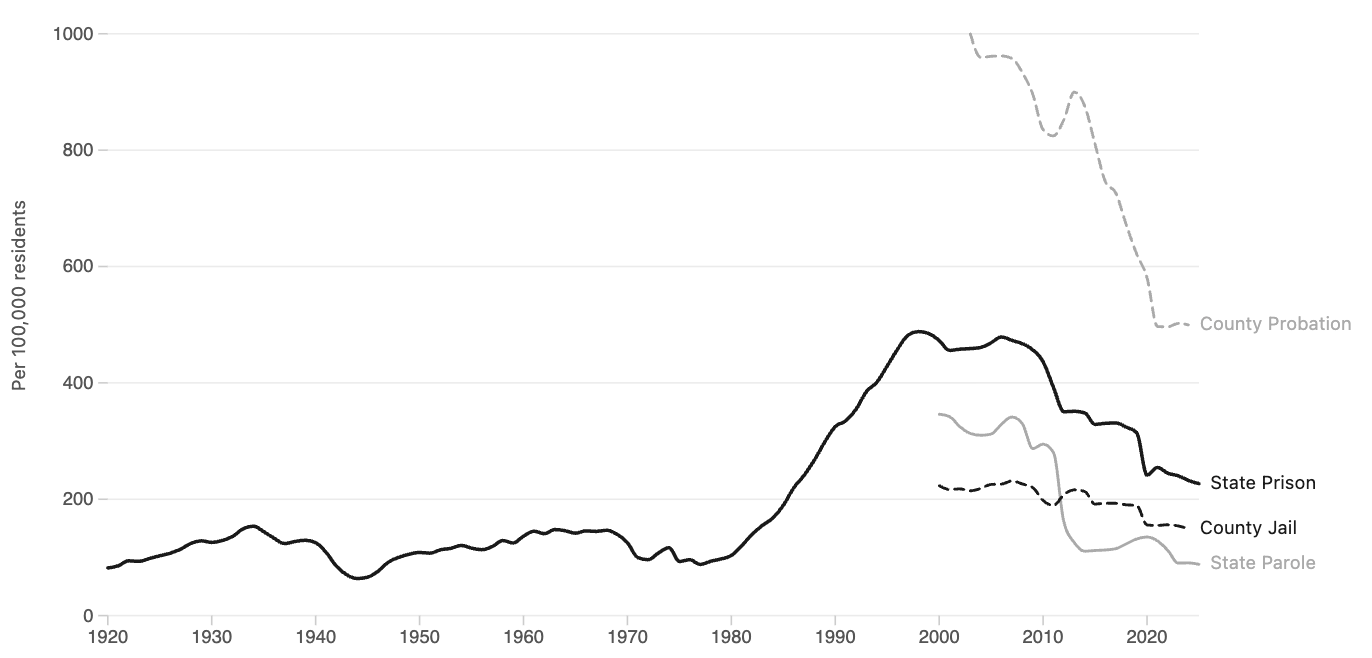
Figure 1. California incarceration rate per 100,000 residents (1920–2025), by state prison, state parole, county jail, and county probation. Sources: CDCR historical records (Zimring & Hawkins); BJS Annual Parole Survey; CA DOJ OpenJustice; FRED CAPOP (US Census Bureau); CA Board of State and Community Corrections (BSCC) Jail Profile Survey.
While incarceration rates declined, funding did not. At the peak incarceration rate in 1998, CDCR’s total budget was $7.44 billion (adjusted to 2024 dollars), or 6.7% of the general fund (see Figure 2). In FY 2024-25, CDCR’s total budget was $14.2 billion, still 6.7% of the general fund, an 89.1% increase in real terms despite housing 43% fewer incarcerated individuals. The rising cost per incarcerated individual is driven by increased costs of infrastructure maintenance and healthcare for an aging prison population, not by investment in rehabilitation or reentry; this aging population is also the most vulnerable during extreme heat events (CCHCS, 2026). This trend extends to community supervision, which many formerly incarcerated moved into; between 2011 and 2024, California’s combined parole and county supervision population fell 44.1% while spending rose 17.6% in real terms, in part because realignment diverted lower-risk individuals out of the state system and left a higher-risk population with more intensive supervision and service needs (Grattet et al., 2018; see Appendix A for population and funding statistics details).
In 2023, Governor Newsom unveiled “The California Model,” inspired by Scandinavian rehabilitative philosophy and evoking the postwar Department of Corrections that treated rehabilitation as a state function (CDCR, 2024b; Simon, 2000). But the model copies rehabilitative prison programming without the welfare state infrastructure that supports Scandinavian outcomes, adding to a corrections system structured around aggregate risk management rather than individual transformation (Cunniff & Gilmore, 2024; Feeley & Simon, 1992). Since 2023, rehabilitation spending has increased to 5.2% of CDCR’s budget ($736.8M), the highest share it has ever been, but still an order of magnitude smaller than facilities spending ($7.4 billion in FY 2024-25, 52.1% of CDCR’s budget; Appendix A).
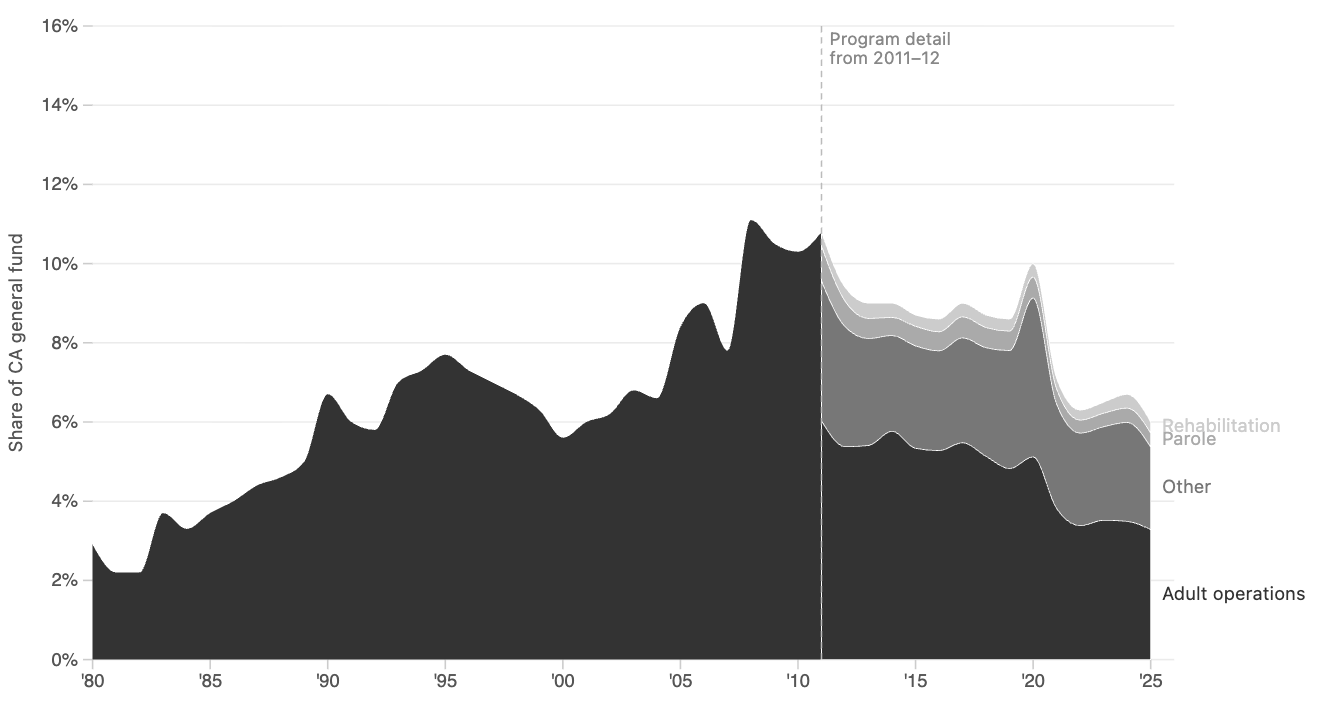
Figure 2. California CDCR spending as a share of California’s general fund (FY 1980–81 to 2024–25) in 2024 dollars. Notes: “Other” = total budget minus adult operations, parole, and rehabilitative programs. Sources: California Budget & Policy Center; LAO Budget Analyses; BJS State Corrections Expenditures; Governor’s Budget chapter 5210.
Racial disparities in both incarceration and heat exposure have persisted through population-level decarceration in the reform era. Black individuals are stopped by police 126.5% more frequently than expected based on residential population (California Department of Justice, 2026); as of 2023, Black men had an imprisonment rate of 2,972 per 100,000 compared to 312 for white men (PPIC, 2024). In Oakland in 2010, gang injunctions targeted Black and Latinx neighborhoods adjacent to gentrifying areas, criminalizing everyday behavior and converting the conditions of poverty into criminal justice contact (Ramirez, 2020); in Southeast San Diego, gang profiling criminalizes communities of color through pretextual police stops (Catalyst California & Pillars of the Community, 2024). Once someone is added as a suspected gang member in California’s gang database CalGang, they can be subject to sentence enhancements that add two years to life; 92% of those sentenced under California’s gang enhancement statute are Black or Latinx (Committee on Revision of the Penal Code, 2020). At the household level, 65% of families of incarcerated individuals cannot meet basic needs for food and housing, a burden that falls disproportionately on women of color who head these households (deVuono-powell et al., 2021). Higher incarceration rates widen the Black-White homeownership gap, and incarceration of a family member reduces household assets by 64.3%, impoverishing the next generation (Schneider & Turney, 2015; Sykes & Maroto, 2016). Formerly redlined neighborhoods have an average 4.7°F higher land surface temperatures (Hoffman et al., 2020; Wilson, 2020); in these neighborhoods, the housing instability and energy poverty produced by decades of disinvestment and wealth extraction turn extreme heat into a form of structural violence, not just a natural hazard (Hamstead, 2023).
The ten largest neighborhood clusters where heat vulnerability and justice system inequity significantly co-occur in California are shown in the inset of Map 1, which highlights the Los Angeles metropolitan area (see Appendix B for details). These neighborhoods contain 4 million people, 10.2% of California’s population. Their residents are 92.2% people of color, are imprisoned at 1.89 times the state average, report housing insecurity at 1.76 times and social isolation at 1.65 times the state average, and 98.4% of the population are in tracts with urban heat island effects. Five clusters are in Greater Los Angeles and the Inland Empire; three are in the Central Valley. By mid-century, the Central Valley clusters will each exceed 140 days above 90°F, and the inland Los Angeles basin clusters will gain more than 37 additional heat days per year (Cal-Adapt, 2025).
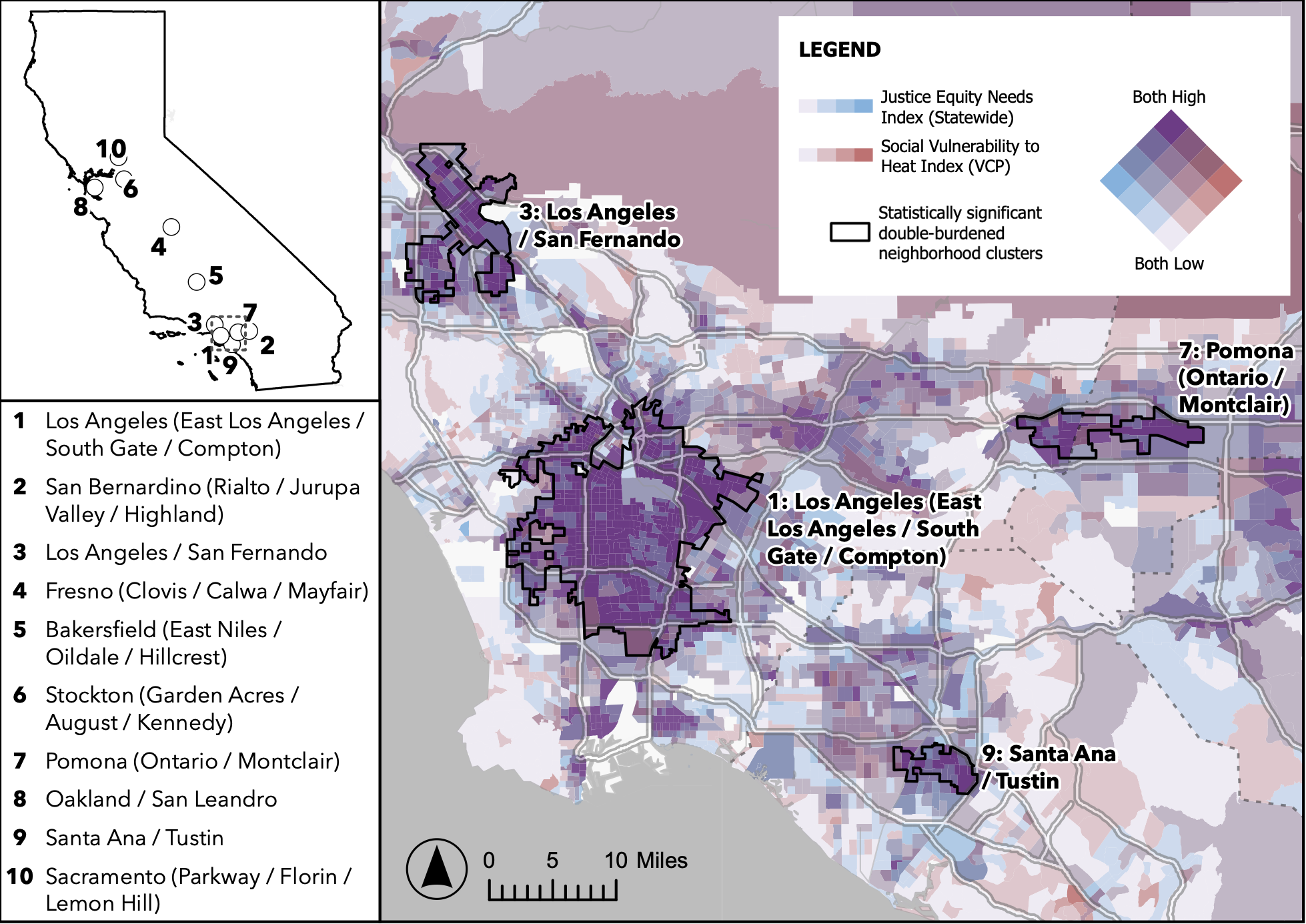
Map 1. Los Angeles neighborhood clusters where incarceration inequality and heat vulnerability co-occur at statistically significant rates. 2.56 million residents (6.5% of California’s population) live in these four Los Angeles clusters; 95.2% are people of color, experience housing insecurity 1.81 times the state average, have an incarceration rate 1.91 times the state average, and all tracts have detectable urban heat island effects. Sources: JENI (author’s adaptation of Advancement Project California, 2022); SVHI (LCI Vulnerable Communities Platform, 2025a). See Appendix B for full methodology.
Disinvestment, segregation, and mass incarceration concentrated extreme heat and criminal justice involvement in the same communities. These are not discrete problems amenable to separate solutions; they are interconnected processes within a larger system, and the efficacy of any intervention depends on how it interacts with the other structures that sustain the pattern (powell, 2010). The post-Plata reforms that reduced California’s incarcerated population by 53% while real corrections spending rose 89% demonstrate how single-indicator reform is absorbed by the system it targets, producing incremental adjustment rather than the structural transformation that stated commitments require (Cairney et al., 2023). The barriers are recursive: structural marginalisation creates institutional obstacles that produce exclusionary policy, which reproduces the conditions for further marginalisation (Pearse et al., 2025). Interventions confined to one policy area such as cooling a prison or distributing water during a heatwave cannot disrupt a feedback loop that compounds across institutions and generations. Each intersect applies abolitionist accountability frameworks to evaluate whether proposed strategies disrupt these recursive conditions by shifting resources and power toward community-based alternatives, or whether they absorb reform energy into the carceral systems and disinvestment that produced them.
As climate change increases the frequency and intensity of heatwaves, it accelerates every dimension of this feedback loop. Nine of the ten warmest years on record since 1895 have occurred since 2014 (CalEPA, 2024). Extreme heat is the leading weather-related cause of death in the United States, claiming more lives annually than hurricanes, floods, and tornadoes combined (Narayanan & Keellings, 2025). A single 14-day heat event in September 2022 caused an estimated $3.2 billion in damages across California; environmental justice communities experienced 20–30% higher mortality across seven major heat events between 2013 and 2022 (California Department of Insurance, 2024). In 2026, California legislative attention is turning to this intersection with the Fifth Climate Assessment being published and the introduction of the Climate Justice and Worker Safety Act (AB-2499, Gipson 2026), also known as Adrienne’s Act, which requires publicly accessible interior temperature monitoring in state prisons. But the state budget is expected to be in deficit, with limited political will to increase spending. The convergence of legislative attention and fiscal pressure creates an opportunity to shift funding toward heat mitigation that addresses historic disinvestment while reducing incarceration, investing in the communities where both conditions concentrate rather than in the systems that produced them.
Shared Methodologies
This capstone combines quantitative and qualitative methods across its three intersects; the two frameworks described below are shared between all three, and each intersect has an additional methodology section describing its specific methods. Intersect 1 applies grant database coding and semi-structured interviews to map community-led resilience investments. Intersect 2 constructs a composite heat risk index and cost model to quantify heat exposure and fiscal impact in state prisons. Intersect 3 conducts a comparative policy document analysis to identify gaps in emergency protocols for community-supervised populations. All three intersects apply peer-reviewed literature to establish the extreme heat risk profile for each population through the shared environmental risk framework below, and assess proposed interventions against the shared abolitionist accountability frameworks.
Environmental Risk Framework
To quantify the impact of heat and criminal justice systems, this paper applies an environmental risk framework (Cardona et al., 2012; Botchwey et al., 2022; Ovienmhada, 2024) in the three intersects to identify:
- Hazard (what): Historic and projected days over a temperature threshold.
- Exposure (where): The geographic and built environment context.
- Vulnerability (who): The population attributes contributing to adverse effects from the hazard.
- Risk (deficits): The potential impact of a hazard measured by combining hazard, exposure, and vulnerability.
- Capacity (assets): The assets of people, organizations, systems, and society to manage or respond to hazard risk.
- Impact (how): The outcomes of hazard exposure on the population, measured by Risk divided by Capacity. When Capacity overpowers Risk, Resiliency is the outcome, and when Risk overpowers Capacity, Disaster is the outcome.
Accountability to Abolition
This capstone applies two abolitionist frameworks as accountability tools across all three intersects. Critical Resistance’s “So is this Actually an Abolitionist Proposal or Strategy?” assesses whether a strategy reduces the power, scope, and number of people under control of the carceral system, or inadvertently expands it (Critical Resistance, 2022). Sanders’ “Carceral Humanism” toolkit identifies interventions that improve conditions within the carceral system in ways that entrench rather than challenge its existence; for example, reforms that increase correctional budgets or expand facility infrastructure under the banner of humane treatment (Sanders, 2026).
There is no exact science to determine if a strategy will result in decarceration or re-entrenchment. The two frameworks are applied to assess whether each intervention reduces the scope of the carceral system and shifts resources toward community-based alternatives, or whether it expands correctional spending, infrastructure, or authority under the justification of reform. Strategies that fail this evaluation may reduce immediate harm but reproduce the conditions that concentrate heat and incarceration in the same communities.