Introduction
Over the past decade, power outage frequency and length in California has significantly increased (CPUC, 2023). This decrease in reliability comes from a combination of many compounding factors: the ongoing deployment of power transmission lines across wildland-urban interface areas (Weiwei, 2025), climate-change-induced rise and severity of extreme weather events such as high winds, wildfires, and heat waves (Loni, 2024), the introduction of utility-sanctioned outages such as Public Safety Power Shutoffs (PSPS) (Murphy, 2021), and unplanned utility-scale supply outages such as the “energy reliability challenges” during California’s 2020 and 2021 heat waves (CAISO, 2022). The increase in power outages uncovered “the disproportionate damages these events cause for underserved communities and have driven energy equity to a renewed prominence” in policymaking (McNamara, 2022).
In 2022 the California Air Resources Board (CARB) updated California’s greenhouse gas (GHG) emissions goal to an 85% reduction by 2045 and highlighted the transition to electricity from fossil fuels as the central strategy to achieve this goal (CARB, 2022). In response to anticipated grid stress from transitioning to renewable generation sources like solar and from increased risk of disruptions from climate-change-related disasters, CARB proposed stabilizing the electricity supply with a near-term 800% annual increase in battery storage, with the goal of 32,000 MW of storage capacity by 2030 (CARB, 2022). In parallel, the California Public Utilities Commission (CPUC) replaced its 1995 Net Energy Metering (NEM) solar tariff in 2022 with a Net Billing Tariff (NBT) program, stating the goals of the replacement were to promote “equity, inclusion, electrification, … and adoption of solar systems paired with storage” (CPUC, 2022). Most of these new programs prioritize grid and market stabilization, but energy equity is now included in all project plans and reports.
McNamara argues that residential energy storage “will be at the heart of the technology solution space” to address “resilience, equity, environmental justice, and decarbonization” for energy vulnerable communities (McNamara, 2022). Residential-scale battery storage attached to solar provides many co-benefit opportunities for low-income or energy vulnerable communities: in addition to reducing the total utility electricity costs of energy-burdened households and generating revenue by paying back into the grid, distributed battery storage can reduce local emission sources by replacing the need for peaker plants, increase resilience during emergencies by keeping essential services and medically vulnerable community members’ homes powered, and provide the opportunity for local wealth creation from new energy sector jobs (UCS, 2019).
According to the California Energy Commission (CEC), by 2024 battery storage capacity in California increased to 13,300 MW. Over half of that capacity was “physically paired with solar or wind generation,” and approximately 10% of that capacity was residential (CEC, 2025). After NBT went into effect in 2023, residential battery storage attachment to solar installations significantly increased, from ~10% to 60%, now averaging 5,000 systems per month (Figure 2), and the average income of households installing solar plus battery shifted from $120k to $80k (Barbose, 2024). Residential battery storage deployments have historically been “concentrated in communities that have higher household income and lower environmental justice concerns” (Brown, 2022), but these recent shifts suggest that California policies, programs, and incentives may be changing that trend.
This paper explores the current policy landscape in California supporting residential battery installations in energy vulnerable communities to understand if and how distributed storage is delivered to these households. First, the terms and frameworks for “energy vulnerability” and “energy equity” are defined based on existing literature. These terms are then used to analyze the stated goals, eligibility criteria, and funding processes of federal and California battery storage subsidy programs, and two recent case studies are used as examples to describe the technocratic deployment process of these funds.
Energy Vulnerability and Energy Equity Definitions
Before analyzing the deployment of California’s current battery storage equity policies and programs, we first must define what energy storage equity is, how it is measured, and the root problem it is attempting to address: energy vulnerability. A review of existing literature and policy reports reveals that there is no agreed-upon definition of “energy equity” or measure of “energy vulnerable communities,” so this paper will identify common themes for each term. Understanding if or how a subsidy defines “energy vulnerable” in its goals or eligibility criteria is critical to assessing the effectiveness of a program’s reach and “energy equity” outcomes for that population (UCS, 2019).
Energy Vulnerability
Themes found in the definitions of “energy vulnerable communities” include: long-term socioeconomic and health impacts from proximity to fossil fuel industries and pollution, household energy financial insecurity, frequency of power outages, frequency and severity of environmental disasters, accessibility to power outage mitigation technologies like solar and batteries, and more specific individual or household attributes related to the health and economic impacts of power outages.
In her history of American environmental racism, Shalanda Baker states “poor people and people of color are more likely than others to live in the shadows of major energy facilities or in communities that house waste generated by power plants” (Baker, 2021). The most frequently used measure of this historic exposure to fossil-fuel-generating industries in California policy is the California Communities Environmental Health Screening Tool (CalEnviroScreen), which calculates census block vulnerability using socioeconomic factors (such as poverty and educational attainment), environmental health effects, and pollution exposures (OEHHA, 2021). The CPUC uses CalEnviroScreen scores plus median household income to define “Disadvantaged Vulnerable Communities” for policies to address the energy insecure (CPUC, 2022). Brown also relies on the CalEnviroScreen measures to define zip codes with “environmental justice concerns” (Brown, 2022), and the Union of Concerned Scientists suggests that California policymakers utilize CalEnviroScreen to identify “fenceline communities,” those that live near “industrial facilities and bear the greatest burden of pollution impacts” (UCS, 2019).
McNamara defines energy insecurity as when “households must consider difficult tradeoffs between personal comfort, health, and economic stability” (McNamara, 2022), measured by energy burden as a percentage of income (Figure 1). McNamara adds community-scale attributes to this economic definition, including the trend that electrification technologies such as solar and storage tend to be installed by the more affluent, who disproportionately benefit, while the cost burdens of “generation, storage, transmission, and distribution” are borne by all ratepayers (McNamara, 2022).
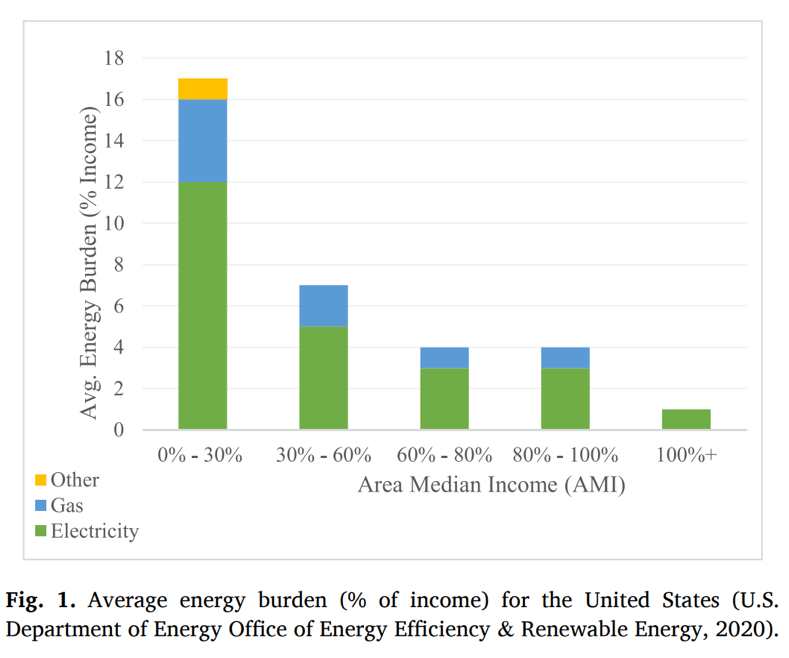
Figure 1. Average energy burden (% of income) for the United States. Source: McNamara, 2022.
McNamara’s definition also includes frequency and duration of power outages and related damages from environmental disasters, both of which cause disproportionately larger economic damages in “underserved communities” (McNamara, 2022). The Union of Concerned Scientists defines this aspect of vulnerability as “frontline communities,” those that bear “the brunt of climate change impacts and often have the least amount of resources to adapt or move out of harm’s way” (UCS, 2019). Xie includes historic exposure rate to PSPS outages (Xie, 2025), and Loni includes historic exposure to power outages (Loni, 2024) in the Social Vulnerability Index (SoVI) they create for their research.
In addition to these historic and economic factors, many researchers add specific vulnerability attributes for individuals whose health and quality of life are “intricately linked to a continuous power supply” (Xie, 2025). Baker describes individuals who have the most trouble bouncing back from disasters and power outages as “living paycheck to paycheck, disproportionately Brown and Black, and often hav[ing] underlying health conditions that require reliance on life-saving home medical devices powered by electricity” (Baker, 2021). Xie’s SoVI accounts for population health statistics for those with disabilities and specific diseases who rely heavily on continuous electricity (Xie, 2025); similarly, Loni defines a SoVI using demographics such as age, individuals with medical conditions, and educational attainment (Loni, 2024).
Energy Equity
This paper utilizes Baker’s definition of energy equity; themes include distributional equity of system benefits and costs, procedural equity in the planning and deployment of programs, representative equity in recognition and communications, and restorative justice to address past harms (Baker, 2021). Baker calls for a “structural transformation of the energy system [and energy governance] as we know it” to become more democratic and decentralized (Baker, 2021).
Many energy equity program goals echo McNamara’s definition, which is limited to distributional equity, where the goal is to “ensure that underserved communities receive the benefits resulting from grid modernization efforts across the electric system, and do not disproportionately incur costs, both monetary and non-monetary, to maintain parts of the system that do not result in direct benefits for their communities” (McNamara, 2022). The Union of Concerned Scientists similarly argues that equity in energy storage programs “contribute[s] significantly to building a clean energy economy that works for everyone” (UCS, 2019). CPUC mentions other equity themes beyond distributional equity, including restorative justice, but they are limited to discussion in their “Environmental & Social Justice Action Plan” (CPUC, 2022).
These themes identified in “energy vulnerable communities” and “energy equity” will now be used to evaluate the equity effectiveness of California’s NBT market incentive for battery storage, battery storage subsidy programs, and two case studies utilizing these programs.
California’s Net Billing Tariff Market Incentive
The NBT program is now the regulated market incentive for all interconnected solar projects in PG&E, Southern California Edison (SCE), and San Diego Gas & Electric (SDG&E) territories. NBT customers get paid to export electricity to the grid based on its “utility value” — the cost the utility would pay if it were buying clean energy elsewhere at the time of the export — and are charged for electricity they receive from the grid based on the time of day (CPUC, 2021). This incentivizes NBT customers to sell electricity at peak hours, when it is most valuable, and store electricity at non-peak hours; in this way NBT incentivizes customers to install battery storage with their solar in order to buy low and sell high on a daily basis. Increased distributed storage addresses CPUC’s goal to reduce the “clean energy shortfall in the evening hours when the sun is down, which forces California to rely on fossil fuels to meet evening demand” (CPUC, 2021). NBT also added a flat-rate “Grid Participation Charge” for customers, which CPUC claims will reduce the existing cost shift of non-NEM customers (disproportionately low-income) paying increasingly higher rates while NEM customers (disproportionately higher-income) pay less into the grid (CPUC, 2021).
Simultaneous to the NBT change in 2023 came an update to California’s Title 24 Building Standard, requiring all new residential buildings to include solar and be “battery ready” (Barbose, 2024). This regulation plus the market incentive changes in NBT appears to have significantly increased the rate of storage installs (Figure 2).
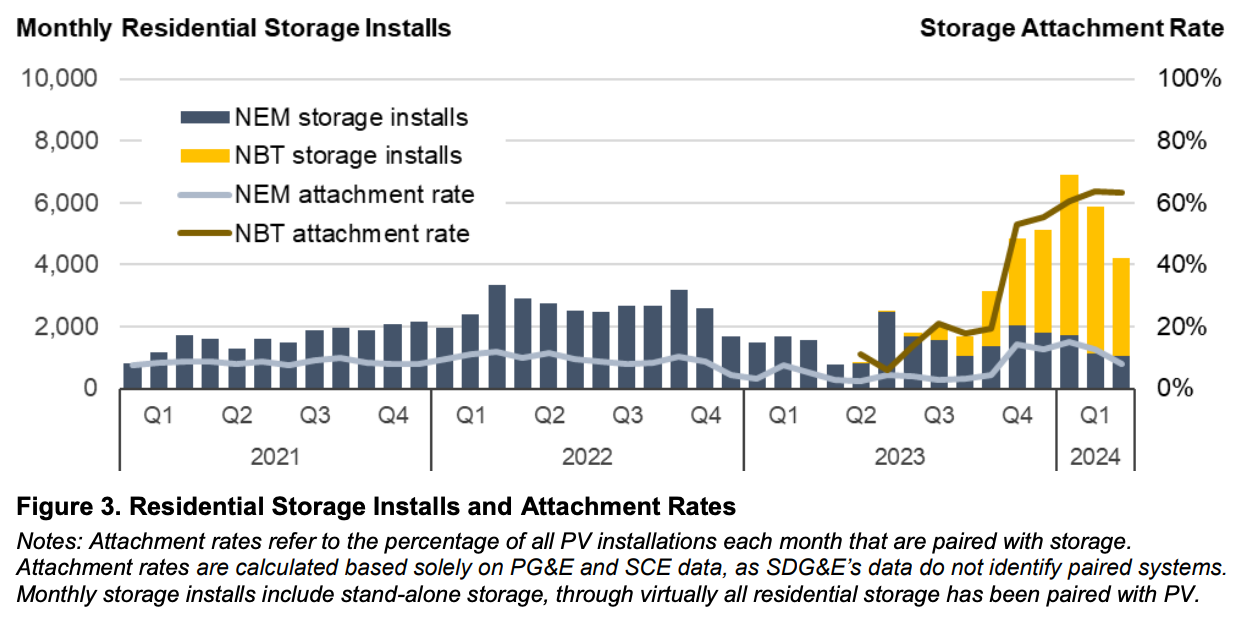
Figure 2. Residential storage installs and attachment rates. Source: Barbose, 2024.
The NBT program proclaims that it promotes equity in two ways: its Equity Fund, “with up to $600 million to support clean energy and storage programs for low-income Californians,” and its exemption from the Grid Participation Charge for low-income customers, customers in Disadvantaged Community census tracts, and tribal households (CPUC, 2021). Low-income NBT customers that install solar within the first few years of the program also receive “transitional adders” on their export electricity rates. There is no published reporting on the utilization of the Equity Fund; it is possible the funds were distributed to existing programs such as the Self-Generation Incentive Program Residential Solar and Storage Equity fund.
Barbose found a significant decrease in the zip-code average income of solar and battery installations after NBT went into effect, from approximately $120k to $80k (Barbose, 2024). Barbose suggests two theories on why this shift may have happened: firstly, because of the Title 24 update, this lower average income may simply reflect where new construction is being built in the state; secondly, various low-income incentives and subsidies may have increased installations in those households (Barbose, 2024). More data will be needed to clearly identify the influences of the shift; however, Barbose’s findings suggest that CPUC made progress on its goal of “promoting equity” with NBT program changes (CPUC, 2021).
NBT’s market mechanisms address distributive equity for NBT customers by reducing the cost of energy per household, introducing a potential new revenue source in selling stored energy, and attempting to distribute rates more evenly with the Grid Participation Charge. Built into the incentive to install battery storage via the time-of-day rate structure is the assumption that household battery storage leads to reduced energy vulnerability during a power outage — however, CPUC does not describe or mention any indicators of energy vulnerability in policy and plan documents for NBT. They also do not feature the energy equity principles of procedural equity, representative equity, or restorative justice in NBT policymaking.
Residential Battery Storage Subsidy Programs
Federally, individuals can claim the Residential Clean Energy Credit on their tax return for 30% of the expenses of “new clean energy property” (which includes solar and battery storage), with no income limitations (IRS, 2025); in 2023, 1.2% of tax returns that claimed the credit were in California, but the majority of these were filed by higher-income households (Eye on Housing, 2024). In 2023 the IRS began offering a “Clean Electricity Low-Income Communities Bonus Credit Amount Program” for commercial projects that meet “environmental justice criteria at the community scale or meeting income criteria at the customer household scale” that are below 5MW of capacity (Bourg-Meyer, 2023). This adder provides an additional 10–15% of clean energy tax credits for wind, solar, and “connected storage capacity” (Bourg-Meyer, 2023). Given that an average single-family household installs a 15 kWh battery and 5 kW of solar (CPUC, 2025) and the 5MW per-project capacity limit, this adder applies to any development of less than 250 single-family homes — this is a tax credit targeting large housing developers.
In California, there have been many solar subsidies and assistance programs available since 2009, the most recent being Disadvantaged Communities – Single-family Solar Homes (DAC-SASH) and Solar on Multifamily Affordable Housing (SOMAH) (Table 1) (Energy Solutions, 2025). These are intertwined with the Self-Generation Incentive Program (SGIP), the subsidy for energy storage.
Table 1. Installed residential capacity (MW and percent of total residential installations) from incentive programs in California
| Program | 2021 | 2022 | 2023 | 2024 |
|---|---|---|---|---|
| DAC-SASH solar | 1.52 MW (0.14%) | 2.10 MW (0.12%) | 2.98 MW (0.16%) | 2.91 MW (0.30%) |
| SOMAH solar | 7.47 MW (0.66%) | 9.35 MW (0.55%) | 3.76 MW (0.20%) | 16.24 MW (1.66%) |
| SGIP battery storage | 35 MW (16.78%) | 51 MW (28.67%) | 30 MW (12.52%) | 53.5 MW (4.29%) |
The SGIP was established in 2001 “as a peak-load reduction program” and was updated many times; in 2016 it became primarily an energy storage subsidy when 75% of the budget was dedicated to storage (Center for Sustainable Energy, 2025). In 2018, the program was modified by CPUC to prioritize funding communities located in Tier 3 and Tier 2 high fire threat districts, communities that have experienced two or more utility Public Safety Power Shut-off (PSPS) events, “critical facilities that support community resilience” serving those districts, and “low income and medically vulnerable customers” (CPUC, 2025). The timing of this policy change to shift funds away from large-scale storage projects to wildfire-prone disadvantaged communities affected by PSPS was partially influenced by political pressure to speed up stalled residential battery projects near recent wildfires (McNamara, 2022). The detailed eligibility criteria are a list of complex measures, including whether the individual lives in single- or multi-family housing, whether they are located in a Disadvantaged Community census tract, and whether they participate in DAC-SASH or SOMAH. In response to this complexity, CPUC recommends individuals work with “a professional installer” to identify if they qualify and how to secure the rebate via the utility, and their suggested first step is to “do a little research” (CPUC, 2025). CPUC authorized $280 million for SGIP’s Residential Solar and Storage Equity budget in 2025, with the intention that the incentive covers “the majority of the cost for the installation of solar and energy storage technology” for those households (CPUC, 2025).
In 2022, Brown determined that “the majority of SGIP-funded battery storage is adopted in zip codes with higher average median incomes and low environmental justice concerns” (Brown, 2022). Brown attributes this disparity partially to the fact that a large proportion of the funding is distributed to regions in the Tier 3 and 2 high fire threat zip codes, where median income and home ownership rates are higher, there are lower rates of high CalEnviroScreen scores, and higher rates of White households (Brown, 2022). Brown also suggests that barriers to adoption for energy vulnerable communities are similar to research findings in solar subsidy adoption, such as “access to financing, high upfront costs, lower home ownership, and/or a lack of peer effects” (Brown, 2022). Because NBT and Title 24 went into effect after Brown’s research, it is unknown if this disparity changed after 2023; further research is needed.
These subsidies, similar to NBT, primarily address distributive equity for battery storage. SGIP does attempt to target energy vulnerable populations more directly, with the inclusion of areas more likely to experience an outage (from wildfire or PSPS) and the medically vulnerable. However, in implementation and process SGIP promotes very little procedural justice beyond poorly-documented quarterly public workshops (CPUC, 2021), and there is no focus on representative or restorative justice. SGIP, like the other subsidy programs, appears to shift the responsibility of engagement and delivery of their “equity” to utility companies, developers, or third-party energy companies — demonstrated with two case studies.
Two Residential Case Studies
Because the policies and subsidy programs are so limited on procedural, representative, or restorative justice for energy vulnerable communities in their goals and eligibility criteria, it is useful to look at examples of projects that have utilized the programs to reveal if and how energy vulnerable community members are involved and empowered.
The first case study is the Bassett–Avocado Heights Advanced Energy Community project (BAAEC), a “state-funded residential decarbonization project undertaken in a low-income, pollution-burdened, and unincorporated area of eastern Los Angeles County” (Cudd et al., 2025). The residents opted in to participate in the Community Solar program through an online discount, and were pursued as “leads” for the Advanced Home program, a pre-designed intervention with free rooftop solar, battery storage, heat-pump water heaters, and induction stoves, funded through DAC-SASH, SGIP, and federal tax credits. Cudd found through interviews that most of the homeowners interacted with the program staff as they “would any other private construction contractor” and had very little active participation in the design of their new energy systems (Cudd et al., 2025). Between the incentive programs and community members was a complex organizational and financial system (Figure 4), in which the third-party providers Sunrun, Energy Coalition, and Swell Energy “expressed their desire to develop a ‘simple’ VPP pilot for low-income market segments … [to] serve as a model for networked battery operation by private firms in other disadvantaged communities” (Cudd et al., 2025).
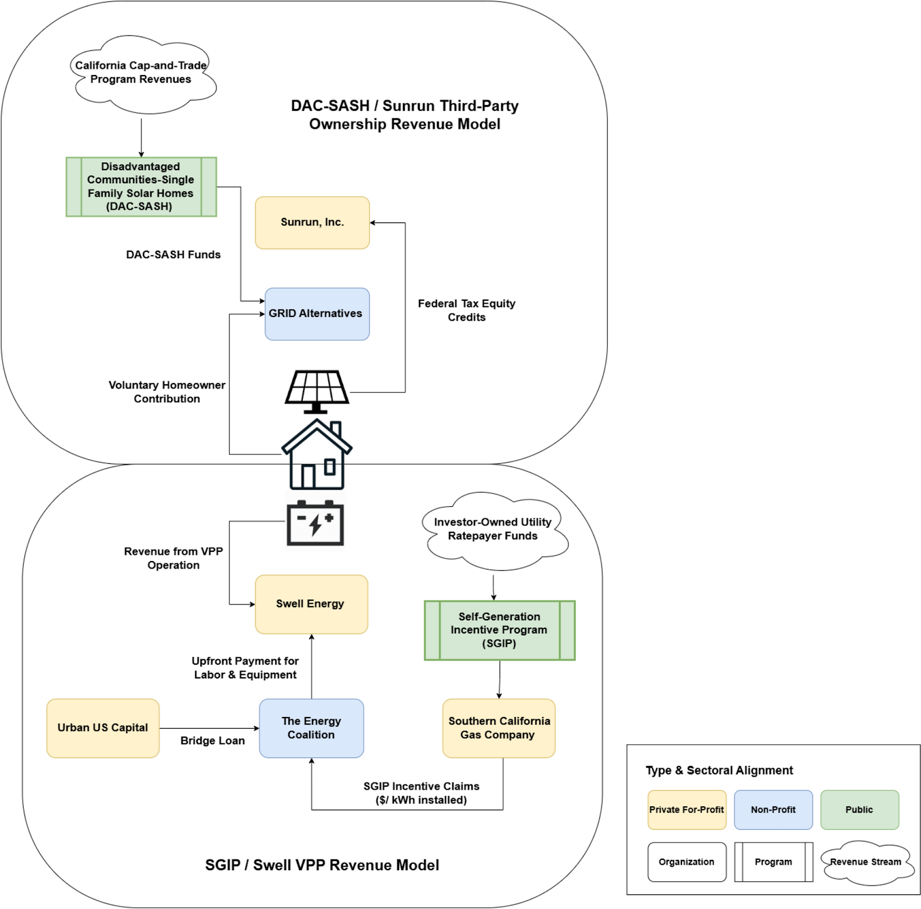
Figure 4. “Example of actors and revenue flows with a third-party ownership revenue model with DAC-SASH subsidies plus VPP revenue model using SGIP subsidies, for BAAEC Advanced Homes solar PV and storage systems.” Source: Cudd et al., 2025.
The process of the project demonstrates that the subsidies, and the organizational systems they funnel funds into, prioritize the construction of “distributionally equitable outcomes with existing technologies and business models” instead of advancing any procedural justice principles that could transform the community into empowered, involved, and energy-resilient — despite project partners’ stated desire for community involvement (Cudd et al., 2025).
The second case study is a solar and battery installation in three affordable housing apartment complexes in Orange County, announced with a ribbon cutting in April 2025 (Sunrun, 2025). Similar to the BAAEC project, third parties Sunrun and Ecoplexus, in addition to the affordable housing developer (Eden Housing), designed and implemented the project and delivered the upgrades at no cost to the residents via SOMAH, tax credits, and SGIP (Sunrun, 2025). Without interviews and further research, we can only speculate on if and how residents were involved in the planning and implementation process. The language used in media coverage only highlights economic benefits in renters’ monthly energy bill savings via NBT. Sunrun also suggested the projects create economic activity for residents through employment but did not specify if the renters in these communities were employed in their own buildings’ projects (Sunrun, 2025). This project marketing again emphasizes economic equity, or distributive justice via reduced energy burden, and leaves out any procedural equity, representative equity, or restorative justice.
Conclusion
Cudd concludes that projects like these two case studies anticipate “an egalitarian, ecomodernist future where all individuals and communities are positioned to benefit from the adoption of residential decarbonization measures” (Cudd et al., 2025). Reduced economic energy burden and the potential for new income streams from NBT is an immediate benefit for energy vulnerable households. But the high cost of energy and fossil-fuel pollution burden was a product of utility- and state-scale programs and plans to begin with; at best it can be said that these economic benefits of battery storage are taking steps toward restorative justice, but without any of the programs furthering or even describing restorative justice goals, it is a flimsy argument. The co-benefit potential for residential battery storage in energy vulnerable communities is indeed promising — distributed renewable battery storage reduces local emission sources by replacing the need for peaker plants and increases resilience during emergencies by keeping essential services and medically vulnerable community members’ homes powered. SGIP’s eligibility criteria and goals do make gestures toward these benefits of reduced energy vulnerability, but the program’s technical and bureaucratic complexity in distribution, along with the technocratic scalability motivations of third-party implementers of the funding, hinders any opportunity to require restorative or representative justice for the energy vulnerable.
Further research is needed for self-service solar and battery storage at the scale of a home appliance to assess the impact of this new system on energy vulnerability and equity. Solar plus battery storage units that plug into wall outlets, with no “interconnection agreement required with your utility company,” are available in the U.S. for the first time as of May 2025 (Ricker, 2025). Made possible by cheaper and smaller microinverter technology, the system can be set up either inside or outside, so installation barriers equalize for homeowners or renters, in multi- or single-family housing. The price of a solar plus battery system by EcoFlow is $2,400 (Ricker, 2025), nearing the price point of a home appliance, and will likely reduce further with technology advancements and market competition. This introduces a new path to distributed storage without third parties, placing ownership of reducing energy vulnerability on the individual. It remains to be seen if the state will provide incentives or support for this model of distributed storage, or if it poses too much of a challenge to the existing governance of the “heterogeneous urban electrical configurations” (Cudd et al., 2025) of the energy transition.